
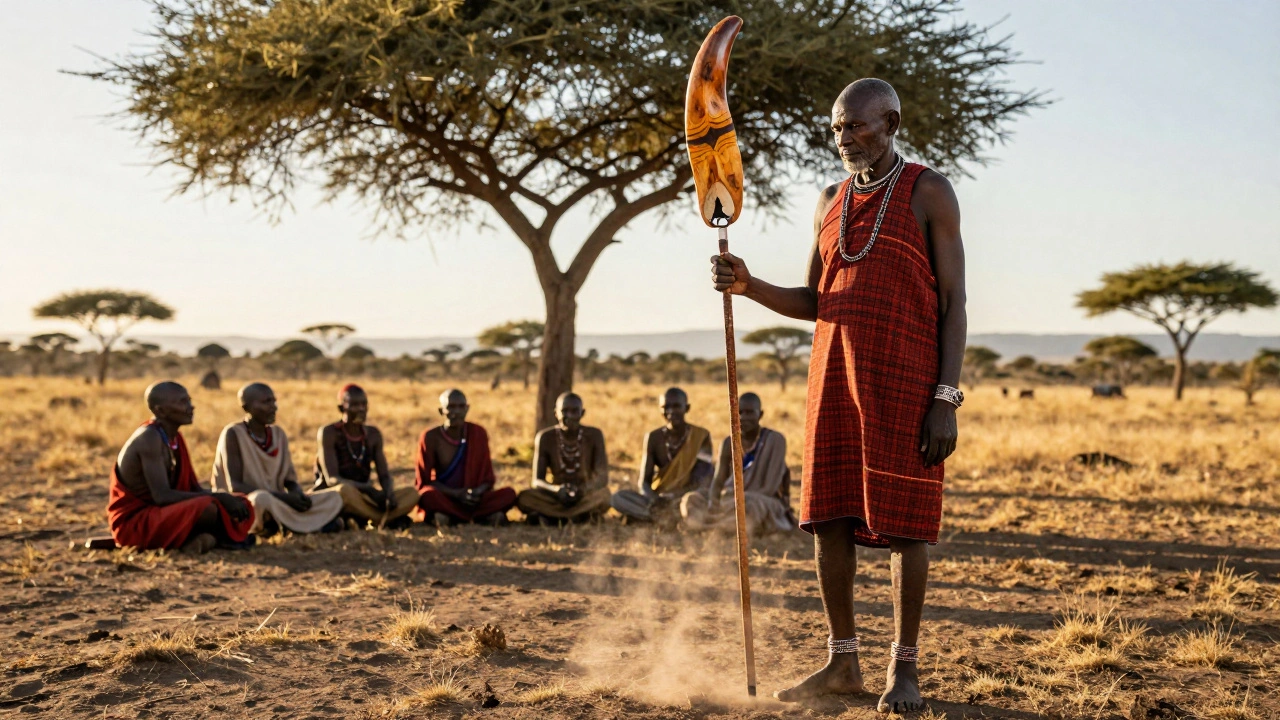
Hold a rungu in your hand and you’re holding more than wood and leather. You’re holding authority. History. A voice that doesn’t need to shout.
What Exactly Is a Rungu?
A rungu is a short, heavy wooden club, often shaped like a flattened oval or teardrop at one end, wrapped in cowhide or leather for grip. It’s not a weapon meant for killing-it’s a tool of presence. Found mostly among the Maasai, Samburu, and other pastoralist groups of East Africa, the rungu is carried daily by men, especially elders and leaders. It’s not tucked away in a corner or stored for ceremonies. It’s worn at the hip, like a belt, always within reach.
The material matters. The best rungus are made from hard African hardwoods like acacia or ebony. The weight is carefully balanced-not too heavy to swing all day, but heavy enough to make a statement when slammed onto the ground. The leather wrap isn’t just for comfort; it’s often dyed with natural pigments, sometimes with patterns that signal clan, age-set, or status. A rungu isn’t bought at a market. It’s made by hand, passed down, or gifted during rites of passage.
The Rungu as a Symbol of Authority
In tribal councils, when a man stands to speak, he doesn’t raise his voice first-he raises his rungu. The moment it hits the earth, silence falls. Not because anyone fears violence. Because everyone knows: this is the signal that wisdom is about to be shared.
Among the Maasai, elders don’t rule by decree. They lead by reputation, by experience, by the quiet weight of their presence. The rungu is the physical extension of that. When an elder taps the ground with it during a dispute, he’s not threatening. He’s saying, Listen. This matters. It’s a non-verbal cue that carries more power than any law book.
Unlike Western leadership symbols-suits, titles, gavels-the rungu doesn’t come from an office. It comes from the land, from generations of herders who learned to read the sky, the soil, and the behavior of cattle. The rungu doesn’t represent power over people. It represents responsibility to them.
How the Rungu Shapes Decision-Making
Imagine a village meeting under a thorn tree. Ten elders sit in a circle. A young man speaks about a stolen cow. He’s angry. His voice is loud. But no one interrupts. Not because they’re polite. Because they’re waiting for the elder with the rungu to speak.
When he does, he doesn’t say, You’re wrong. He says, What did the cow’s tracks tell you before you chased? Then he taps his rungu once. The silence returns. Someone else speaks. Then another. The decision doesn’t come from a vote. It comes from the rhythm of conversation, guided by the rungu.
Studies of Maasai conflict resolution, documented by anthropologists like Dr. Paul Spencer in the 1980s, show that disputes resolved with the rungu’s influence have a 70% higher long-term compliance rate than those settled by external authorities. Why? Because the rungu doesn’t impose justice. It invites reflection.

The Rungu in Ritual and Transition
A boy doesn’t get a rungu when he turns 18. He earns it when he becomes a warrior. The ceremony is simple: his father hands him a rungu that once belonged to his grandfather. No speech. Just the weight of it in his palm. That moment changes him. He’s no longer just a boy. He’s now responsible for protecting the herd, the women, the elders.
Later, when he becomes an elder, he may pass that same rungu to his son. Or he may make a new one-carved from the same tree that stood near his first water hole. The rungu becomes a living archive. Each scratch, each worn patch of leather, tells a story: the drought of 2004, the lion that took two calves, the peace treaty signed under the acacia.
Women don’t carry rungus in most groups, but they hold equal influence. They guide through storytelling, through the songs they sing at night, through the way they choose which sons become elders. The rungu isn’t about gender. It’s about role. And role is earned, not given.
Why the Rungu Still Matters Today
Modern governments have courts. Police. Constitutions. So why do Maasai elders still carry rungus in 2025?
Because when a young man is arrested by police for grazing cattle on protected land, he doesn’t understand the law. But he understands the rungu. When an elder steps between him and the officer, rungu in hand, the officer pauses. Not because he’s afraid. Because he sees something he can’t arrest: dignity.
There’s a quiet resistance here. In a world that values speed, noise, and digital validation, the rungu says: Some things take time. Some voices don’t need to be loud to be heard.
Even in Nairobi, where Maasai youth now live in apartments, you’ll see them keeping a rungu on the wall beside their phone charger. Not as a decoration. As a reminder. Of where they come from. Of who they’re still responsible to.

What the Rungu Teaches Us About Leadership
Leadership in the West is often measured by how many people you can control. In Maasai culture, it’s measured by how many people you can make listen.
The rungu doesn’t command. It invites. It doesn’t punish. It pauses. It doesn’t speak for the leader-it gives the leader space to be silent, to think, to wait for the right moment.
What if your boss carried a rungu instead of a PowerPoint? What if your city council met under a tree, and the person with the most experience got to tap the ground before anyone spoke? Would decisions be slower? Maybe. But would they be wiser? Probably.
The rungu isn’t about tradition for tradition’s sake. It’s about a way of leading that doesn’t rely on fear, hierarchy, or shouting. It’s about presence. Patience. And the quiet power of being heard without having to demand it.
Where to See a Rungu Today
You won’t find rungus in tourist shops labeled as "African tribal weapons." Real rungus aren’t sold for decoration. They’re carried. They’re used. But if you visit the Maasai Mara in Kenya, or the Amboseli region in Tanzania, you’ll see them-on the hips of elders walking to council, resting against a rock while children tend to goats, held gently in the hands of a grandfather telling stories to his grandchildren.
Some cultural centers, like the National Museum of Kenya in Nairobi, display rungus with proper context-not as curiosities, but as instruments of governance. Look for the labels that mention "authority staff" or "leadership symbol," not "war club."
And if you ever meet a Maasai elder who offers you a rungu to hold? Don’t just take it. Listen. Feel the weight. Then give it back with both hands. That’s how you learn.
Is the rungu a weapon?
Not primarily. While it can be used for defense, its main purpose is symbolic. It’s a tool of authority and communication, not violence. Maasai elders use it to command attention, not to harm. Its design is meant for grounding, gesturing, and signaling-not for combat.
Who can carry a rungu?
Traditionally, it’s carried by adult men who have earned status within their community-warriors and elders. Women hold leadership roles too, but through different means: storytelling, spiritual guidance, and family influence. The rungu is tied to male roles in pastoralist societies, but leadership itself isn’t limited to those who carry it.
Are rungus still used in modern Kenya and Tanzania?
Yes. Even in cities, many Maasai men carry a rungu as a sign of identity. In rural areas, elders still use them in village councils to mediate disputes, guide decisions, and maintain social order. Government officials sometimes recognize their authority in local matters, especially around land use and livestock.
How is a rungu made?
A rungu is hand-carved from dense hardwood like acacia or ebony. The head is shaped and smoothed with knives and stones. The handle is wrapped in strips of cured cowhide, often dyed with plant-based pigments. The process takes days. Each rungu is unique, shaped by the maker’s hands and the wood’s natural grain. It’s never mass-produced.
Can tourists buy a rungu?
You can buy replicas in markets, but they’re not the same. Authentic rungus aren’t sold as souvenirs-they’re passed down or gifted. Buying one from a tourist shop often supports cultural appropriation. If you want to honor the tradition, learn its meaning first. Support Maasai artisans directly, and ask how the item was made and why it matters.
If you want to understand leadership beyond titles and power points, watch how an elder holds a rungu. Not like a club. Not like a prop. Like a promise.
 Health and Wellness